Zeqi Zhao’s personal website
Hi, my name is Zeqi Zhao [tsɤ́ tɕʰí ʈʂàʊ̯].
I am currently completing my Ph.D. in Theoretical Linguistics at the University of Göttingen, supervised by Professors Clemens Mayr and Uwe Junghanns. My dissertation examines how focus shapes meaning, using Mandarin dou as a case study. The particle appears to do several unrelated jobs; I develop a probabilistic semantics on which it does one — marking its sentence as the strongest available evidence for the question at hand, measured by the Bayes factor — with its apparent functions following from where focus sits. The project brings Bayesian modeling into formal semantics and connects to experimental work on relevance.
Alongside my research, I am retraining as a data scientist with StackFuel, applying my background in language and formal reasoning to real-world data.
You can also find more information on my institutional page. You can reach me at zeqizhao.zz@gmail.com.
Research Interests
Formal semantics/pragmatics;
The semantics/pragmatics interface;
Logic in language;
Information structure
Data Science
Job ads are written language, and language is what I know best. My current project turns that into a data question: what do German employers actually want from data professionals?
I built a Python pipeline that collects job ads for data roles from the job search of the Bundesagentur für Arbeit, about 2,000 ads with full texts. I then analyse the German-language descriptions to find out:
- which skills are requested most often,
- which skills tend to appear together,
- how Data Analyst and Data Scientist roles differ, and
- what separates junior from senior positions.
Code and documentation on GitHub
Tools: Python · pandas · scikit-learn · Jupyter · Git
Public outreach
Modern theoretical linguistics—particularly generative and formal approaches—often bears the “non-scientific” label. My goal is to show the general public that formal semantics goes well beyond abstract formalisms that resemble “pure math”: formal grammars generate precise, testable predictions that can be directly validated against empirical data.
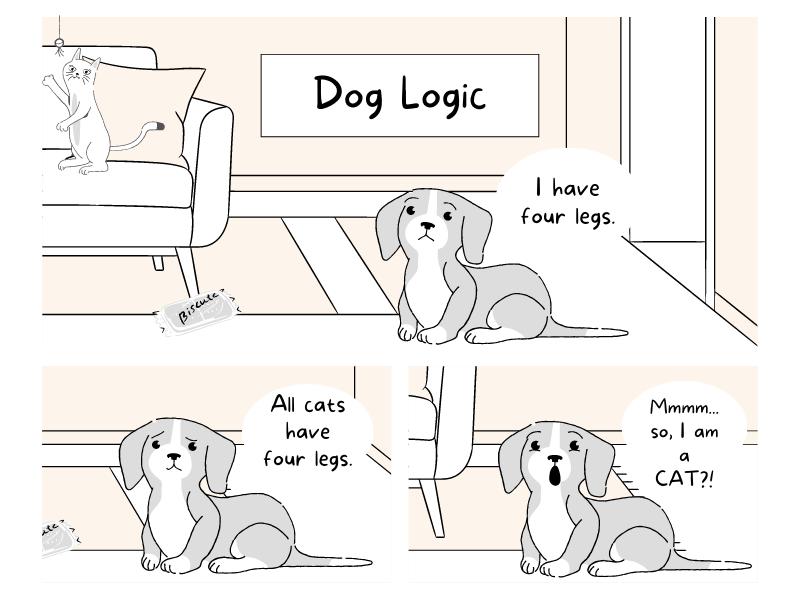
In a joint public talk (with Nina Haslinger) at the 5th Night of Science in Göttingen, I demonstrated how an intuitive understanding of logical consequence is woven into our unconscious language faculty.
Below is the playful comic strip I used in my talk: